What is the best time to visit Muxía?
The best time to visit is between June and September when the weather is mildest and driest. Spring and autumn are also pleasant, though Galicia’s Atlantic climate means rain is possible year-round.
How do you get to Muxía?
The nearest airport is Santiago de Compostela, about 1.5 hours away by car or bus. There is no train station, so travelling by car or regional bus via Santiago is the most practical option.
What are the main things to do in Muxía?
Highlights include visiting the Santuario da Virxe da Barca church and its famous rock formations by the sea, walking the scenic coastal paths, and exploring the harbor and lighthouse area. Muxía is also the final stop for pilgrims on the Camino Fisterra-Muxía route.
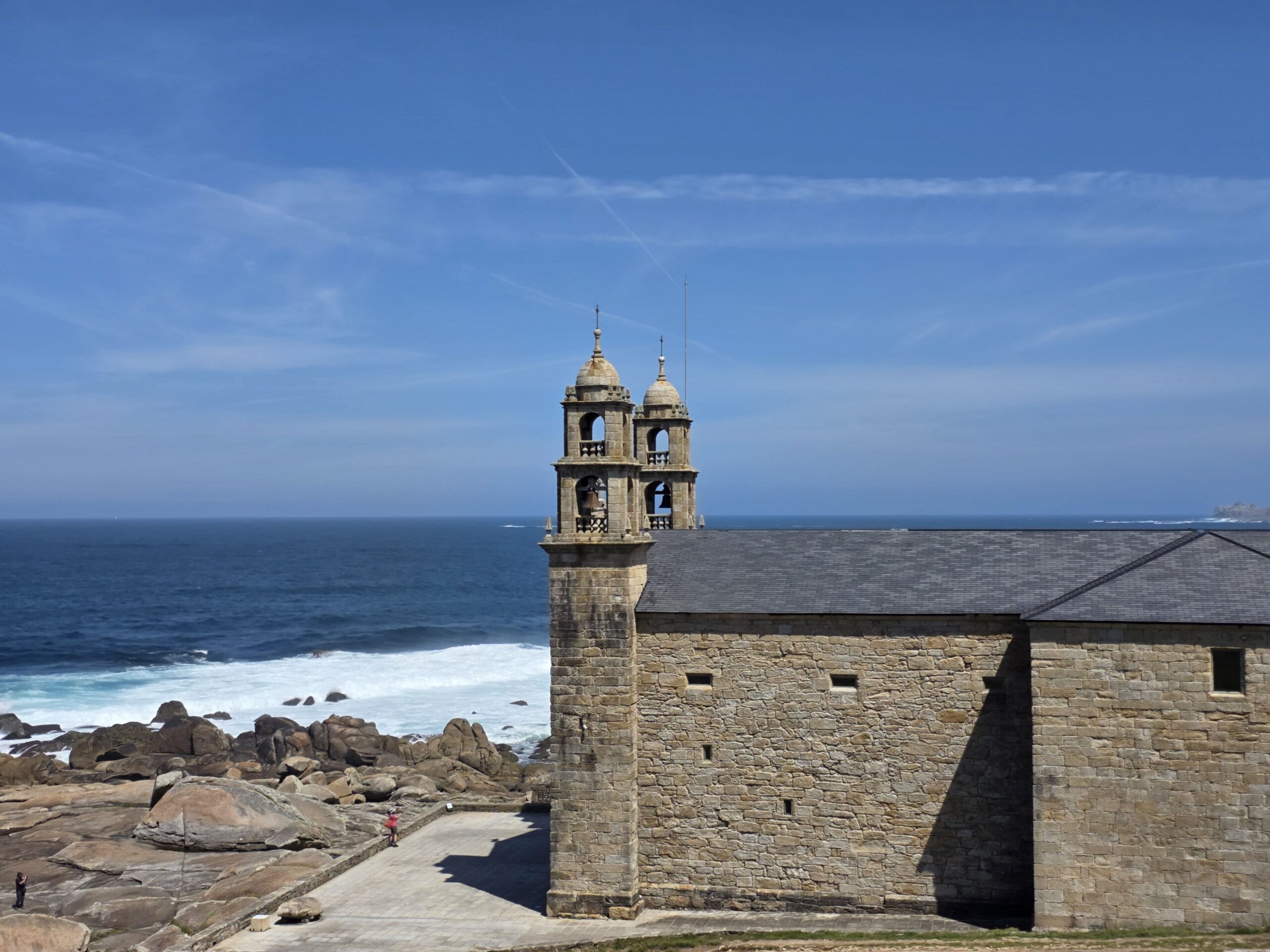
Muxía is a small fishing town on Galicia’s Costa da Morte, where granite cliffs drop straight into a restless Atlantic and legends run as deep as the tides. It’s not a place with a checklist of sights, but a place you feel: wind, salt, myth, and silence. For travellers chasing Spain’s rawer, less-photographed corners, this is as far west and as far from crowds as it gets.
The sanctuary at the edge of the world
Muxía’s defining landmark is the Santuario da Virxe da Barca, a stark stone church perched directly on the rocks of Punta da Barca, waves crashing beneath it. Local legend says the Virgin Mary arrived here by stone boat to comfort the Apostle James, and the surrounding boulders, the Pedra de Abalar and Pedra dos Cadrís, are said to be its petrified remains. The sanctuary burned in 2013 and was carefully restored, but its dramatic setting, arguably one of the most striking in Galicia, remains untouched by time.
A quiet, elemental character
This is a working fishing town first, a destination second, with a harbour full of real boats rather than tourist ones. The pace is slow, the architecture unpolished, and the drama comes entirely from the landscape: sheer cliffs, hidden coves like Praia do Lourido, and the ever-present sound of the sea. Muxía suits travellers who want solitude, long coastal walks, and a genuine sense of arrival rather than curated charm.
The final steps of the Camino
Muxía is one of two coastal endpoints (alongside Fisterra) for pilgrims who extend their Camino de Santiago beyond the cathedral, walking an extra 2-3 days from Santiago de Compostela to reach the sea. Arriving here on foot, with the sanctuary in view and the Atlantic finally underfoot, is considered by many walkers the true emotional close of the pilgrimage. Even non-pilgrims can walk short stretches of this coastal route for spectacular sea views.
Percebes and the taste of the Costa da Morte
Local food here revolves around what the sea gives up, often at real risk to those who harvest it. Percebes (goose barnacles) are gathered by hand from wave-battered rocks along this coast and are considered some of the finest in Spain, served simply steamed with sea salt. Pair them with a plate of pulpo á feira or fresh-caught turbot in one of the harbourside taverns, and a glass of crisp Ribeiro or Albariño wine.
Romaría da Virxe da Barca
In early September, Muxía hosts one of Galicia’s most atmospheric religious festivals, the Romaría da Virxe da Barca, drawing pilgrims and locals from across the region. Expect processions to the clifftop sanctuary, traditional music, seafood stalls, and the striking sight of the Pedra de Abalar ritual, where believers rock the ancient stone to test their conscience, said to move only for the pure of heart.
Climate through the seasons
Spring brings mild temperatures, fresh Atlantic winds, and green, blooming countryside, ideal for walking. Summer is pleasantly warm rather than hot, rarely exceeding 25°C, with sea mists that can roll in unexpectedly even in July and August. Autumn turns dramatic and moody, with strong winds and crashing waves that suit the landscape’s wild character. Winter is mild but wet, with frequent rain and rough seas, the season when the Costa da Morte truly earns its name.
Getting there and nearby combinations
The nearest airport is Santiago de Compostela, roughly 1.5 hours away by car; there’s no train, and while regional buses connect Muxía to Santiago, a rental car gives far more freedom to explore the coast. Muxía pairs naturally with Fisterra just down the coast, the lace-making village of Camariñas, and the wider Costa da Morte’s scattered lighthouses and beaches, plus Santiago de Compostela for a fuller Galician itinerary.